Updated: October 2026
Short answer: Roda de Isábena is the smallest town in Spain with a cathedral — fewer than 50 residents — and, together with the co-cathedral of Monzón and the cathedral of Barbastro, it forms the Three Cathedrals Route in Upper Aragon (Alto Aragón). Three churches for three estates of medieval society (the clergy, the nobility and the common people), from 10th-century Romanesque to 16th-century late Gothic, that are easy to visit in one weekend. One detail shapes the whole plan: the co-cathedral of Monzón is only open on Saturdays and Sundays.
All three belong to the Three Cathedrals Route, one of the 13 sites of the Expedición 4.0 al Medievo (Expedition 4.0 to the Middle Ages), which adds an immersive experience to each visit. This guide explains what to see in each church, how to fit the opening hours together and how to plan two unhurried days.
The three cathedrals at a glance
Each building stands for a different power in medieval society, and that is the key to understanding why they are worth seeing together.
| Church | Who it represents | Period and style | Why it stands out |
|---|---|---|---|
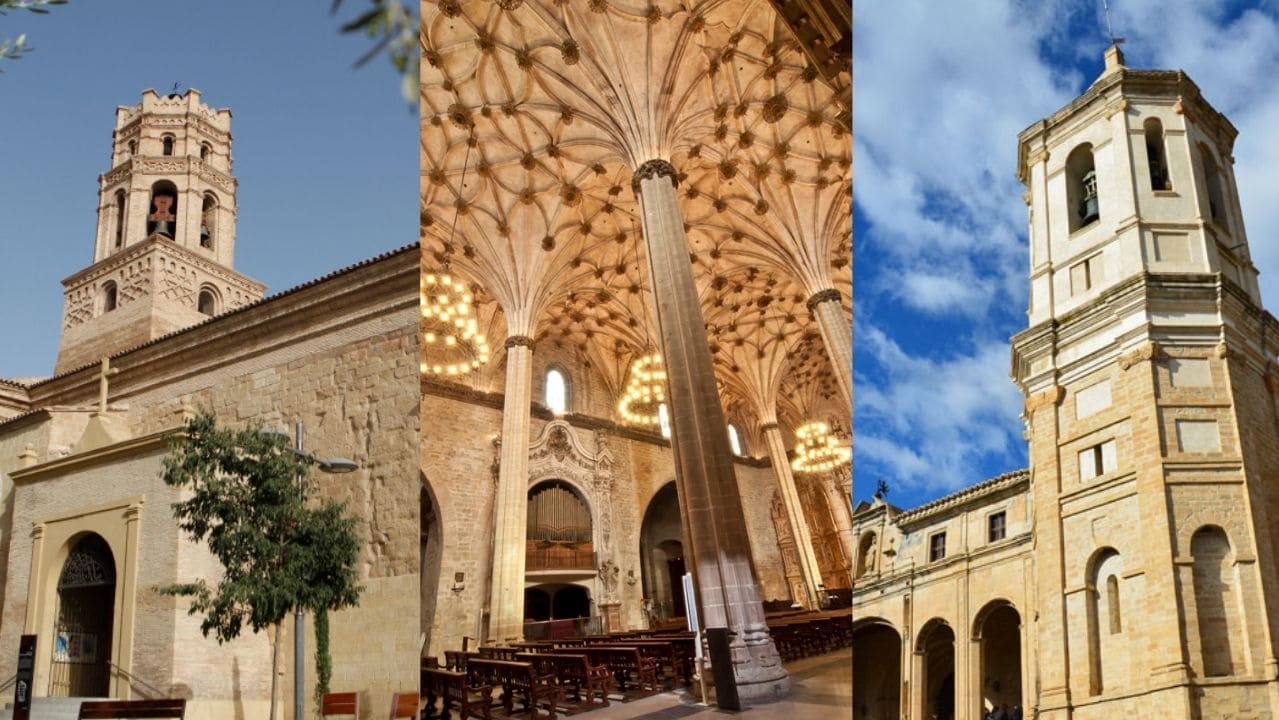
| Cathedral of San Vicente Mártir (Roda de Isábena) | Church power | Consecrated in 956 and remodelled in the 12th century. Lombard Romanesque | The oldest cathedral in Aragon, in the smallest town in Spain with a cathedral |
| Co-cathedral of Santa María del Romeral (Monzón) | The monarchy and the nobility | 12th–13th centuries. Sober Romanesque, with a 17th-century Baroque-Mudéjar tower | Meeting place of the Cortes of the Crown of Aragon, next to the Templar castle |
| Cathedral of Santa María de la Asunción (Barbastro) | The common people who became a bourgeoisie | 1517–1533. Late Gothic with a Renaissance touch | A hall church with columns around 15 metres tall |
Roda de Isábena: the smallest town in Spain with a cathedral
Roda de Isábena stands 907 metres above sea level in the Ribagorza region and has 46 inhabitants, according to the Most Beautiful Villages of Spain association, which it has belonged to since 2019. Its cathedral of San Vicente Mártir was consecrated in 956 at the initiative of Count Ramón II of Ribagorza and remodelled in the 12th century. It is considered the oldest cathedral in Aragon and has been a National Historic-Artistic Monument since 1904.
A precision, to be accurate: the building no longer works as a cathedral, but it was an episcopal see between the 10th and 12th centuries and the village keeps the popular title. It is a perfect example of how a tiny place could be a centre of power in the heart of the Middle Ages.
A see with a library and a scriptorium
Its first bishop was Odisendo, the count’s own son. Under his leadership Roda had a notable library and scriptorium, that is, a workshop where manuscripts were copied. For a mountain village in the 10th century, that says a lot.
Saint Ramon and the crypt
Saint Ramon, the second bishop, who was of French origin, was persecuted and found refuge in Roda. On 27 December 1170, with Alfonso II of Aragon present, his remains were moved to the polychrome Romanesque sarcophagus in the crypt. His grave goods include Egyptian and Central Asian textiles with Arabic inscriptions, a sign that the Middle Ages were also a time of contact between cultures. The cathedral also holds the remains of Saint Valerius, patron saint of Zaragoza.
The theft by Erik the Belgian
In 1979, the thief known as Erik the Belgian took Saint Ramon’s chair, which ended up cut into pieces, and the Limoges enamels from the reliquary of Saint Valerius. Part of what was stolen was recovered. It is one of those stories that change the way you look at an object once you have it in front of you.
What to see in the village besides the cathedral
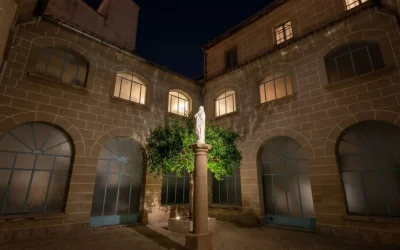
- The cloister, small and austere, and the crypt with its slender columns.
- The Plaza Mayor (main square) and the Santa Ana gateway, a natural viewpoint over the Isábena valley.
- The Prior’s palace, next to the cathedral.
- The former refectory, now the Hospedería La Catedral, entered through the cloister. A good place to eat without leaving the medieval complex.
- The medieval bridges over the Isábena river, for a short walk with views.
Monzón: the cathedral of the Cortes next to the Templar castle
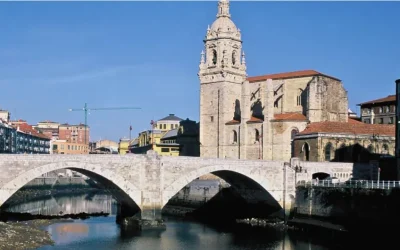
The co-cathedral of Santa María del Romeral was built in the 12th and 13th centuries on the site of the city’s first Christian church, consecrated at the end of the 11th century. It is a sober Romanesque building with three naves and a triple apse, to which a brick Baroque-Mudéjar tower was added in the 17th century, contrasting with the ashlar stone of the rest of the building. “Romeral” refers to a field of rosemary.
Its fame comes from politics. According to Aragon Tourism (in Spanish), several sessions of the Cortes of the Crown of Aragon were held in this church, which makes sense in a city lying between Aragon, Catalonia and Valencia. Its walls witnessed intrigue, pacts and power struggles, and that is the story the experience puts in the foreground. It stands next to the Templar castle, which is worth seeing on the same day.
Important: Monzón can only be visited on Saturdays and Sundays, from 12:45 to 13:30. It is the piece that decides when to do the route.
Barbastro: the cathedral the people built
The cathedral of Santa María de la Asunción was built between 1517 and 1533 in a late Gothic style with a Renaissance touch. It is a hall church: three naves of equal height with star-shaped rib vaults resting on six columns around 15 metres tall that recall palm trees. The art historian Fernando Chueca Goitia ranked it among the most beautiful hall churches in Spanish religious architecture.
The city itself raised it, hoping to win back the episcopal see. The site had gone from mosque to church, then to collegiate church and finally to cathedral, a journey that explains the pride of a trading city. The high altarpiece, in alabaster and polychrome wood, has a base that Damián Forment began and his disciple Juan de Liceyre completed. Inside there are also 12th-century wall paintings from San Vicente de Vió, in Sobrarbe.
Barbastro is also the capital of Somontano and its Wine City, so the cathedral fits naturally into a getaway with wineries and good food. If that appeals, the Somontano Wine Festival is held on the first weekend of August.
How to plan the weekend: suggested itinerary
Three facts drive the plan. Monzón is only open on Saturdays and Sundays, Roda is closed on Tuesdays, and Barbastro and Monzón are about 17 kilometres apart, roughly 17 minutes by car according to Rome2Rio. Roda lies further north, in the Isábena valley, along the A-1605 from Graus. This is a suggested route, not a fixed itinerary: always check the hours when you book.
Option A: Roda on Saturday, Barbastro and Monzón on Sunday
Saturday. Spend it in Roda de Isábena. Visits run at 11:15, 12:30, 13:30, 16:30 and 17:30, so you can go up in the morning or the afternoon. Eat at the Hospedería La Catedral and stroll around the village at an easy pace.
Sunday. Start in Barbastro, which opens at 11:00, and leave enough time to reach Monzón before its 12:45 to 13:30 slot. Afterwards there is time to see the Templar castle.
Option B: Barbastro and Monzón on Saturday, Roda on Sunday
If you would rather finish in the mountains, do Barbastro from 10:00 and Monzón at 12:45 on Saturday, and keep Sunday for Roda, with visits from 11:15 to 17:30. In both cases, August and Holy Week are busier: book in advance.
Opening hours and price of the Three Cathedrals Route
| Cathedral | Days and visiting hours |
|---|---|
| Roda de Isábena | Monday: 11:15, 12:30 and 13:30. Wednesday to Sunday: 11:15, 12:30, 13:30, 16:30 and 17:30. Closed on Tuesdays. |
| Barbastro | Tuesday to Thursday: 11:00–13:00 and 16:00–18:00. Friday: 11:00–13:00 and 16:00–19:00. Saturday: 10:00–13:00 and 16:00–19:00. Sunday: 11:00–14:00. |
| Monzón | Saturdays and Sundays only, 12:45 to 13:30. |
| General admission | €10 |
These are the hours and the fare valid in October 2026. They may change with the season, so check the up-to-date calendar and book your visit before you set off.
What you will experience in each cathedral with Expedición 4.0
The Expedición 4.0 al Medievo links 13 sites in 7 autonomous communities through immersive audiovisuals, video mapping and interactive content. If you do not know the project yet, read what the Expedición al Medievo 4.0 is. On this route, each cathedral is told through a different thread:
- Roda de Isábena: coexistence between cultures and the transfer of Saint Ramon’s relics. The Middle Ages were not only about conflict.
- Monzón: medieval politics, kings, queens and nobles, with intrigue and power struggles as the backdrop.
- Barbastro: architecture in the leading role, with guilds, the bourgeoisie, foundations and vaults.
If you continue to the Pyrenees after Aragon, in Jaca you will find Ecos de la Seo, where the cathedral tower opens to the public for the first time.
Frequently asked questions
What is the smallest town in Spain with a cathedral?
Roda de Isábena, in the Ribagorza (Huesca), with fewer than 50 inhabitants. Its cathedral of San Vicente Mártir is considered the oldest in Aragon, although it no longer works as a cathedral.
What is there to see in Roda de Isábena?
The cathedral of San Vicente Mártir with its crypt and cloister, the Plaza Mayor, the Santa Ana gateway as a viewpoint, the Prior’s palace and the medieval bridges over the Isábena. You can eat at the Hospedería La Catedral, set in the former refectory.
How long does it take to see the three cathedrals?
A weekend is ideal. Monzón is only open on Saturdays and Sundays, and Roda lies further north, in the Isábena valley, so it deserves a day of its own.
On which days can the co-cathedral of Monzón be visited?
Only on Saturdays and Sundays, from 12:45 to 13:30.
How far is Barbastro from Monzón?
About 17 kilometres by road, roughly 17 minutes by car according to Rome2Rio.
How much does the Three Cathedrals Route cost?
General admission is €10. Before you go, check the up-to-date calendar and prices on the booking page.
Ready for Upper Aragon? Pick your weekend and book your visit to the Three Cathedrals Route. Full details of the site are on the Three Cathedrals Route page.